"Nikas Industries" and its product "Seed-Spine" are fictional, and this plan was built as a class assignment in constructing a marketing and go-to-market strategy. The product claims, the customer-research profiles, the pricing, the Stryker "partnership," the physician endorsements, and especially the simulated results (market share, number of customers, net profit) are all fabricated for the assignment, they are not real business outcomes, real partnerships, or real clinical facts. It appears in this portfolio to demonstrate applied use of marketing frameworks, not to assert anything factual. (Note: this plan describes "Seed-Spine" as biodegradable and self-expanding, which is not a real device capability.)
Slide 1 (title): "SEED-SPINE: The best expandable spine rods system."
Presentation objectives Slide 2
The deck sets out to introduce the product, its market, the competitor, and Nikas Industries' strategy to capture share of the least-invasive expandable spine-rod market.
Background: expandable rods Slides 3–4
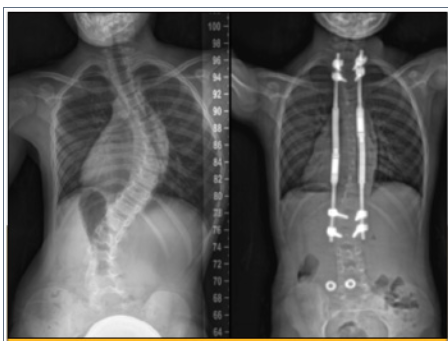
Part 1, What expandable rods are
- Rods are a treatment option for patients with scoliosis, a deformity in which the spine curves laterally.
- Patients are typically between 2–10 years of age.
- How they work: expandable rods are attached to the top and bottom of the spine and periodically lengthened until the spine is straightened.
- They are an alternative to spinal fusion. Fusion in children limits spinal growth and prevents the ribcage from expanding, which can crush the growing lungs.(1)
Part 2, Two types of expandable rods
- Traditional expandable rods require surgery every ~6 months to be manually expanded.
- Least-invasive rods, Magnetic Expansion Control (MAGEC) rods by Nuvasive are expanded in-office by a magnetic device, without surgery. Surgeons may X-ray or use ultrasound to check rod position.
- Some surgeons prefer MAGEC for fewer surgeries and X-rays.(2)
- Nuvasive is described as owning essentially the entire market share of least-invasive expandable rods.
Company & strategy Slides 5–7
Nikas Industries facts (as stated)
| CEO | Aedan Nikas |
|---|---|
| Size | Start-up |
| Product(s) | Seed-Spine |
| Employees | 20 |
| Team | No sales team; a strong marketing team was hired |
| Current market share (least-invasive expandable rods) | 0% |
| Current customers | None |
Marketing strategy (12-month timeline)
Nikas Industries aims to capture substantial market share of the least-invasive expandable spine-rod market within 12 months:
- July 2024: Establish a partnership with orthopedic-device company Stryker to gain money, resources, and experienced sales reps.(3)
- Aug 2024 – Oct 2024: Convince Ivy-League-educated pediatric orthopedic surgeons (ideally with multiple patents) to endorse Seed-Spine.
- Nov 2024 – June 2025: Convince consumers of the competitor brand, Nuvasive, to switch to Seed-Spine rods.
Mission statement Slide 7
"Nikas Industries aims to have Seed-Spine be the most-used spine system for treating young children with scoliosis." The stated reason it will be number one: of all scoliosis spine implants, it is positioned as the least invasive, most imaging-friendly, and most team-friendly.
Target market Slides 8–9
Target: Nuvasive MAGEC users and potential users. The profile below came from a small stated sample of five surgeons using MAGEC rods; traits were chosen for their assumed effect on a surgeon's purchase decision.
| General area of residence / fellowship | East Coast (60–80% of sample) |
|---|---|
| Insurance accepted | Aetna (80% of sample) |
| Gender | Male (100% of sample) |
| Hospital size | More than 343 beds (100% of sample) |
- Psychographic profile: using GeoVALS, the most over-represented East-Coast profiles are Innovators and Thinkers; since MAGEC users mostly reside on the East Coast, they are treated as Innovators and Thinkers.(5)
- Purchase motivation: MAGEC users value fewer surgeries(6) and fewer X-rays / less radiation than traditional expandable rods.(7)
Competitor analysis: Nuvasive SWOT Slides 10–11
Strengths
- Spine innovation
- Global distribution
- Large patented product portfolio
- Research capabilities
Weaknesses
- Dependence on the spine market
- Legal challenges including physician-kickback issues
- Manufacturing and operating costs challenge profit
- Supply-chain disruptions
Opportunities
- Expanding markets
- Partnerships such as Globus
- Increasing elderly population
- Minimally invasive surgery (MIS)
Threats
- Large medical-device competition
- Constantly changing healthcare regulation
- Economic fluctuation(8)
Unique selling proposition Slide 12
Seed-Spine's stated advantages over MAGEC expandable rods (fabricated device claims):
- Less invasive: installed endoscopically through two very small incisions vs. MAGEC's larger incisions; also described as biodegradable, "melting" in the body once the spine is straightened, avoiding removal surgery.
- No X-rays: claimed to be visible under UV light in the body, with self-expansion correlated to the child's growth rate, eliminating radiation that MAGEC requires.
- Sterile-processing friendly: framed as easier for surgical techs and SPD technicians, letting the surgeon lead a more effective team.
Pricing strategy Slide 13
- MAGEC rods cost at least $13,125; Seed-Spine is priced at $10,000 flat (attributed to the "biodegradable material"), covering surgery, item cost, worker compensation, and office visits.
- Insurance is claimed to cover most of the rod price; Nikas Industries offers an interest-free month-to-month plan.
- Cost is projected to fall as volume grows, "especially after Stryker buys Nikas Industries."
Promotional plan Slide 14
- Flyers sent to MAGEC users' clinics, depicting Ivy-League-educated, patent-holding pediatric orthopedic surgeons endorsing Seed-Spine, chosen because Ivy League signals "Thinkers" and patents signal "Innovators," matching the MAGEC-user psychographic.(9)
- In-person selling: Stryker sales reps present Seed-Spine's advantages in the OR and clinics, appealing to surgeons' self-image as the most caring doctor and team leader.(10)
Marketing budget Slide 15
| Allocation | Share |
|---|---|
| Stryker partnership meetings & fees | 10% |
| Convincing ideal endorsers (July 2024) | 20% |
| Promotional activities for MAGEC users | 70% |
Action list Slide 16
Flyers
- Hire a marketing manager and graphic designers.
- Have the regulatory team review whether advertisements are FDA-friendly.
- Flyers ready to ship by October 31, 2024; sent via first-class mail.
In-person selling
- Hire a travel coordinator for sales-rep travel; find the best commission rate.
- Hire a budget planner for hotels and business costs; hire sales strategists to decide which reps go and when.
- All completed by October 31, 2024.
Simulated results of strategy Slide 17
The figures below are an invented "results" slide for the assignment. They are not actual market share, sales, or financial results.
| Market share of least-invasive expandable rods achieved | 56% |
|---|---|
| Number of customers | 233 |
| Company outcome | Went public and was bought by Stryker |
| Net profit | $1.1 million |
References Slide 18
- "Growing Rods for Scoliosis." YouTube, April 6, 2018. youtube.com/watch?v=VSb-0KwfEV0.
- "Growing Rods for Pediatric Scoliosis." Michael G. Vitale, MD, MPH, May 8, 2024. pediatricscoliosissurgery.com.
- "Magnetic Rods Help Young Scoliosis Patient Avoid Surgery." YouTube, October 12, 2017. youtube.com/watch?v=rw2fY-DNDZo.
- Tybout, Alice, and Bobby Calder, eds. Kellogg on Marketing. New Jersey: John Wiley & Sons, Inc., 2010.
- The4. "What Are the Strengths, Weaknesses, Opportunities and Threats of NuVasive, Inc. (Nuva)? SWOT Analysis." dcf. Accessed June 16, 2024. dcf.fm/products/nuva-swot-analysis.
- VALS Program. "GeoVALS: Connecting Motivations with Geography." California: SRI Consulting Business, 2006.
References reproduce the deck's own citation list. In-copy citation markers (1)–(10) point to these sources as numbered in the original presentation.